
Sound Therapy for Dogs – A Human – Dog Sound Bath Experience
LONDON March 8th 2026 – 3.45pm – 5.15pm
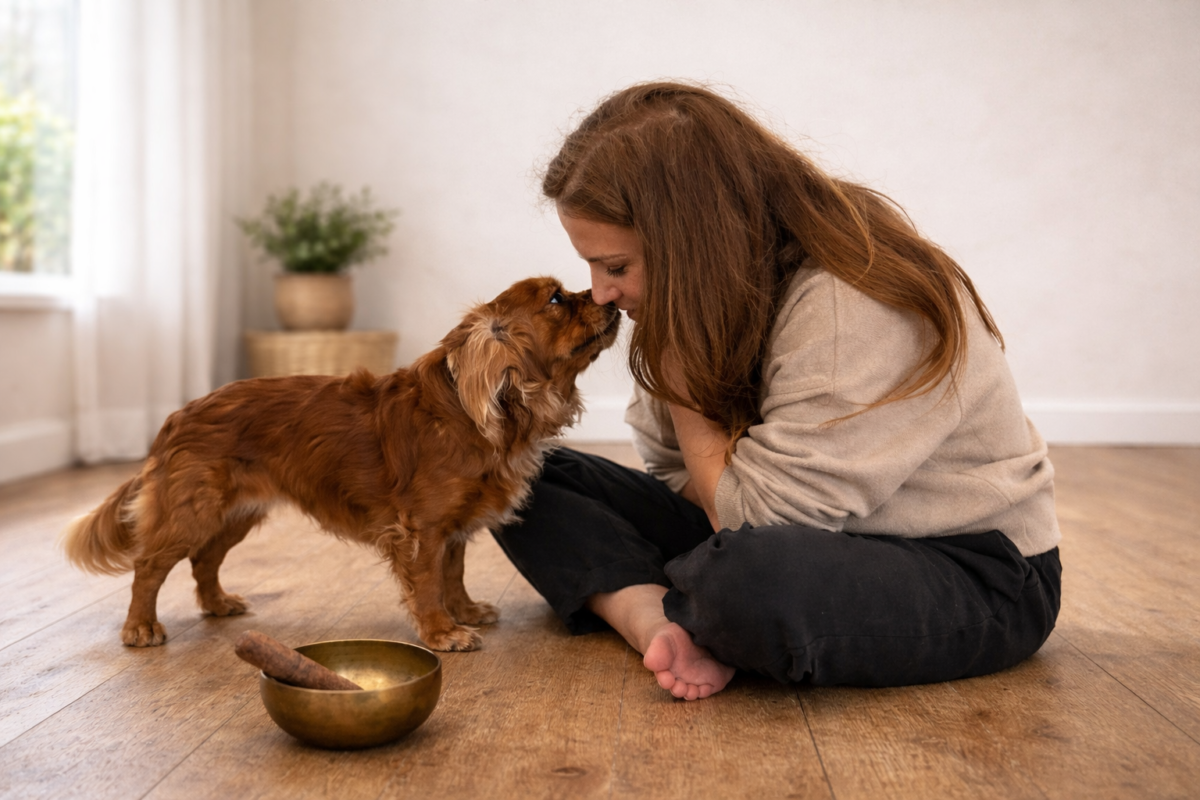
I am delighted to be collaborating on an in-person workshop exploring sound therapy for dogs and their humans through a shared sound bath experience. Carefully designed and thoughtfully held, this session offers a calm, supportive environment where both species can rest together in sound. Gentle movement, live vibration and stillness are woven together to support nervous system regulation and relaxation, with group sizes intentionally kept small so that each human–dog pair can be held with care.
This offering has a playful and rather beautiful origin – the world’s first human-dog sound bath is, quite literally, the brainchild of a dog. What unfolds is a carefully structured experience that invites calm, connection and shared presence across species. The space is best suited to well-socialised, calm dogs who are comfortable resting alongside their humans; service-dog training is not expected, only a gentle readiness to settle into sound together and share the experience with ease.
What to expect from this human–dog sound bath
This 90-minute practice brings sound therapy to both of you. Experiencing it together creates something more.
You and your dog enter a softly prepared space. Each human-dog pair has a designated area, separated from others for safety and calm. You will have your yoga mat. Your dog will have their familiar bed or cave from home positioned nearby. This provides a safe space where they can settle or, if comfortable, move closer to you on your mat.
You will be guided through gentle yin yoga. The slow, restorative postures are designed not to disturb your dog. Our sound therapist creates an immersive sound bath using singing bowls, gongs, and chimes. The sound frequencies support both human and canine nervous systems. Occasionally, storytelling is woven through the sound.
At certain moments, you will be invited to connect with your dog through gentle touch if you wish. You may also choose to remain in shared stillness.
As the sound deepens, stillness often emerges in both of you. Your calm influences theirs. Theirs influences yours.
You listen.
You are together.
Who this is for?
- This experience suits people who enjoy, or are curious about, sound baths and want to share calming experiences with their dog.
- It is for people who feel closely bonded with their dog and are drawn to exploring what happens when humans and dogs rest together in sound.
- No prior experience with sound baths or yoga is required.
What this is and what it is not
- This is a well-being experience that offers therapeutic benefits. Sound therapy for dogs and humans can support deep relaxation, calm the nervous system, and strengthen the connection between you and your dog.
- It is not a therapeutic intervention for mental health difficulties or a behavioural treatment for dogs.
- If you are seeking mental health support, we invite you to explore our directory of well-qualified yoga therapistswho are expertly trained in this area.
Why We Are Doing This: Minnie's Story
Sound has a profound power – to calm, to heal, to connect. For both humans and dogs, sound therapy creates measurable changes in the nervous system, supporting relaxation and well-being.
This offering emerged from Minnie’s journey. When Heather travelled to Sweden for work, she left three-month-old Minnie in the care of Minded lecturer Raquel Chinchetru, who introduced Minnie to music to help her feel safe. Perhaps this formative experience set the stage for what was to come – or perhaps Minnie was always meant to bring this gift to us. Either way, through a host of experiences that would unfold, Minnie was communicating with us.
Heather, who writes music in her free time, began composing songs for Minnie with sounds and melodies Minnie responded to. When Heather played them, Minnie would curl up and fall asleep. When fireworks scared her, Heather would play the same calming music and pull Minnie close – and she would settle.
As time went on, something curious began to happen. Minnie would approach people who were lying down and press her neck firmly against their mouths, wrapping herself tightly around their faces. Everyone would laugh at this peculiar behaviour, wondering why she would do this. One day, a neighbour who Minnie had known for years picked Minnie up and gently began kissing her neck. Minnie closed her eyes and lifted her neck higher, asking for more. Heather began doing this as well, and then playfully nuzzled on Minnie’s neck. Minnie would return again and again, lifting her neck to request it. Heather put two and two together: Minnie was placing her neck on people’s mouths to feel the vibration.
This understanding deepened when Heather was considering signing up for a Reiki training and asked if Minnie could attend. She was welcomed from the beginning. During the two days of teaching, Minnie was completely still and silent. Whenever someone approached her, she would wag, give love, and then settle again. She was beloved by the whole group. The founders felt Minnie had a special presence and wanted to give her initiation, sensing she carried something unique. Following the training, Heather would practise Reiki on Minnie, and when she stopped, Minnie would paw at her for more.
Things continued to unfold. One day, whilst Heather was lecturing on her yoga therapy training, Minnie crossed the room making a strong “woo woo woo” sound toward a student – a sound she makes when ignored and wanting attention. She’d never done this during a lecture before. Heather publicly apologised. The student explained that she’d been giving Minnie Reiki every day during in-person modules and had forgotten that day.
In August, Heather went on a prolonged retreat in Corfu, Greece, where sound baths were held every other night. Minnie had already been joining every yoga session; having grown up with the Minded Institute, she knew how to be present in these spaces. Heather asked if Minnie could join the sound baths. She was allowed. Minnie fell into deep relaxation, snoring even. When sessions ended, she refused to leave, physically pulling Heather by her lead towards the sound bath room every time they passed. Heather began researching the benefits of sound healing for dogs; she is always focused on Minnie’s health and wanted to know more. The evidence was very promising, and suddenly everything came together: a human-dog sound bath could become an actual therapeutic experience.
Heather had long wanted to bring Minnie to actual yoga and wellness sessions where Minnie could benefit too: experiences designed for both of them, with dual benefit, and she knew she was not alone. She called Odile, who confirmed the potential from a veterinary perspective, and Shaura, another dog lover and sound therapist, who felt immediately: “This needs to come to the world.”
This knowledge sparked something really special: an offering where both species could truly benefit together.
The Research
For humans, research shows sound therapy influences the nervous system – lowering cortisol levels, increasing heart rate variability, and activating the parasympathetic nervous system ScienceDirect. These physiological changes support the body’s natural healing processes. Sound therapy is now being used in clinical settings to support cancer patients, improving quality of life, reducing anxiety and pain, and helping with disease-related fatigue PubMed Central, PubMed Central. In dementia care, music therapy has been shown to enhance cognitive functions including memory, attention, and executive function PubMed CentralSpringer. The presence of dogs in therapeutic settings has also shown benefit – research on the therapeutic alliance in psychological therapy shows mixed but promising results when dogs are present PubMed Central, and a study of 467 undergraduate students found that online sessions with therapy dogs present elicited significantly greater stress reduction compared to sessions without dogs The Conversation.
For dogs, the research is emerging but compelling. As we all know, their hearing is far more sensitive than ours – they perceive frequencies and vibrations we cannot. Research dating back to the 1990s shows that dogs respond to specific sound characteristics: long, sustained notes with slow tempos have been universally used to calm dogs PetMD, McConnell Publishing Inc.. Classical music consistently leads to increased resting behaviours, reduced barking, and measurable decreases in stress indicators including lowered cortisol levels and heart rate PetMD, PubMed Central. Sound frequencies between 25-150 Hz have been shown to aid in bone growth and fracture healing Soundhealingtools, and high-energy sound waves are used in veterinary medicine to increase blood flow, reduce inflammation, and support healing Bergheimpetvet.
The human-animal bond offers something beyond individual benefit. Research demonstrates synchrony in the autonomic nervous systems of dog-owner pairs, with heart rate variability patterns modulating between both species during interaction PubMed Central. Both humans and dogs show increases in oxytocin and decreases in cortisol during positive interactions ScienceDirect, PubMed Central, creating a positive feedback loop similar to mother-infant bonding Science. What this means: each species influences the other’s nervous system state, supporting mutual regulation.
This experience brings these elements together. We’re exploring what emerges when humans and their dogs both experience sound therapy in a carefully designed shared environment – and documenting what we discover.
Location and Practical Details
When: Sunday, March 8th, 3.45pm to 5.15pm
Where: 33 Wadeson St, Cambridge Heath, London E2 9DR, United Kingdom
Price: £40 per human-dog pair
This is a small group of 8 to 10 human-dog pairs. The intimate setting allows both species to feel safe and held.
Dogs must be no more than 10kg and able to:
- stay calmly with their human
- be comfortable around other dogs
- settle in new environments
Dogs are not expected to be service dogs. However, if your dog requires therapeutic or behavioural support themselves, this environment may be too stimulating and may not be the right fit.
Odile, our veterinarian, will speak with all applicants beforehand. This ensures the sound therapy for dogs workshop is a good fit for both you and your dog.
Keeping the group intentionally small means spaces are limited.
The Teachers
Heather Mason is the founder of The Minded Institute and a yoga therapist. Heather created this offering with Minnie after years of observing Minnie’s deep connection to vibration and sound.
Shaura Hall is a yoga therapist, sound therapist and founder of The Yogologist. Shaura holds the sonic space with singing bowls, gongs, and chimes, creating the immersive sound journey.
Doctor Odile Sicouri is a yoga therapist, Minded Institute Supervisor, yoga teacher and veterinarian with over 30 years of experience, with a particular interest in animal behaviour.
